
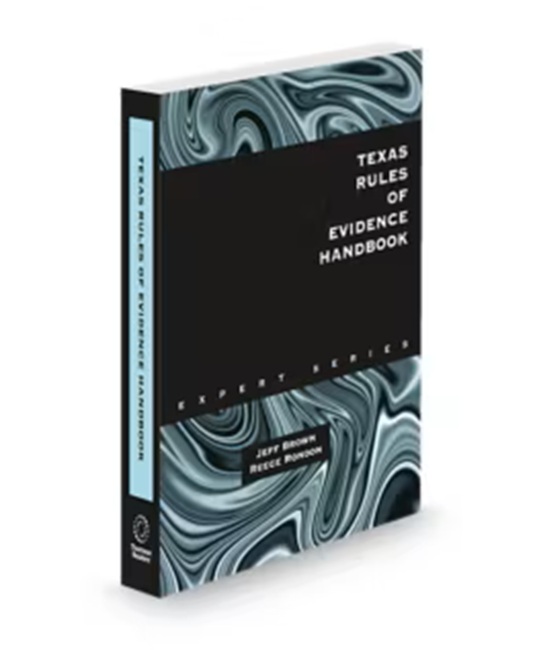
Description
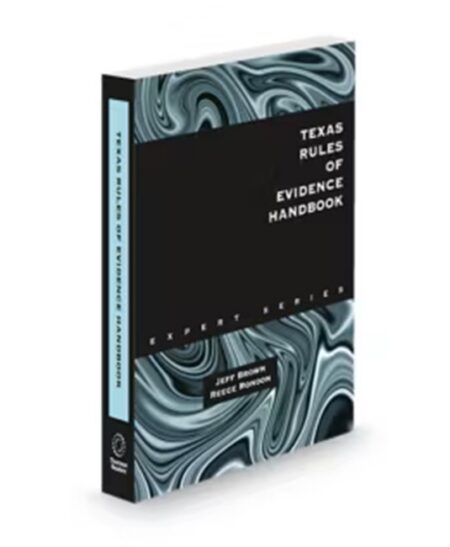
The Texas Rules of Evidence Handbook provides in-depth commentary and substantive analysis of the Texas Rules of Evidence for both civil and criminal cases. Written and edited by expert practitioners, the handbook explains the history, purpose, and effect of each rule. The commentary is backed by thousands of citations to rules, cases, and secondary sources. The handbook contains the following: The complete text of the Texas Rules of Evidence, including the official notes and comments Ten chapters more than 1,000 pages explaining the Texas Rules of Evidence, with rule numbers on tabs for quick reference Comparison between the Texas and Federal Rules of Evidence What’s New in This Edition This year’s edition of the Texas Rules of Evidence Handbook has been updated to reflect 2025 legislative changes, 2024 rule amendments, and new developments in case law. We have also revised parts of the commentary to improve clarity and add further explanation. Some of the changes we made this year include the following: Throughout the book, we updated the citations to the new ninth edition of the treatise McCormick on Evidence. We updated our discussion of which errors may be treated as fundamental under Rule 103(e) based on Irsan v. State, 708 S.W.3d 584 (Tex. Crim. App. 2025). In that case, which involved the defendant’s complaint about a remark made by the trial judge, the Texas Court of Criminal Appeals observed that the state of the law is unsettled and assumed without deciding that the defendant was entitled to appellate review of his constitutional complaint. We updated our discussion of the presumption of unfairness in the fiduciary context based on the 2024 updates to the Texas Pattern Jury Charges on the topic. We updated our discussion of the presumption of recklessness and danger under Texas Penal Code 22.05(c) based on legislative changes that create an exception for peace officers engaged in the lawful discharge of official duties. We updated our discussion of the relation of Texas Rules of Evidence 401403 to nontestimonial evidence to address the 2024 enactment of Federal Rule of Evidence 107. Federal Rule 107 governs illustrative aids (e.g., photos, diagrams, video depictions); that is, information offered not as evidence but instead for the narrow purpose of helping the trier of fact understand what is being communicated by a witness or party. We updated our discussion of the notice requirement under Texas Code of Criminal Procedure article 37.07, 3(g), based on Green v. State, 713 S.W.3d 865 (Tex. Crim. App. 2025). In that case, the Texas Court of Criminal Appeals held that to activate the notice requirement, the defendant must either (1) serve the State with a request for notice or (2) file a discovery motion asking the court to order the notice and secure a ruling on the motion. Id. at 885. We revised our discussion of Rule 412 based on the repeal of former Rule 412 and the adoption of current Rule 412, effective September 1, 2025. In 2025, the Texas Legislature expressly disapproved of Rule 412, as its protections did not extend to victims of human trafficking and certain sexual offenses against children. See S.B. 535, 89th Leg., R.S., eff. Sept. 1, 2025. A new rule has been adopted to cure this deficiency. It applies to the admissibility of evidence in a criminal proceeding commencing on or after September 1, 2025. We updated our discussion of the comparison between Texas Code of Criminal Procedure article 38.37 and Federal Rules of Evidence 413415 based on legislative changes to article 38.37. See H.B. 1778, 4.05, 89th Leg., R.S., eff. Sept. 1, 2025. We updated our discussion of trade secrets based on the enactment of Texas Civil Practice & Remedies Code 134A.0065, which sets out the procedure for sealing documents that contain alleged trade secrets. We updated our discussion of the court’s control of proceedings under Rule 611(a) to address the 2024 enactment of Federal Rule of Evidence 107 and the corresponding amendments to Federal Rule of Evidence 1006. The amendments, among other things, clearly make a distinction between summaries to be admitted as substantive evidence (governed by Federal Rule 1006) and a summary of information offered solely to help the trier of fact understand the evidence (formerly governed by the broad standards of Federal Rule of Evidence 611(a) and now governed by the more particularized requirements of Federal Rule 107). We updated our discussion of witnesses’ prior inconsistent statements to address the 2024 amendments to Federal Rule of Evidence 613. Federal Rule 613(b) was amended to provide that extrinsic evidence of a prior inconsistent statement is not admissible until after the witness is given an opportunity to explain or deny the statement. We updated our discussion of an opposing party’s statements to address the 2024 amendments to Federal Rule of Evidence 801. The amendments added a new last paragraph to Federal Rule 801(d)(2) and provide that when a party “stands in the shoes” of a declarant or the declarant’s principal, hearsay statements made by the declarant or principal are admissible against the party. We updated our discussion of statements against interest to address the 2024 amendments to Federal Rule of Evidence 804. The amendments to Federal Rule 804(b)(3)(B) create another difference between it and Texas Rule 803(24). Federal Rule 804(b)(3)(B) now requires that, in assessing whether a statement is supported by corroborating circumstances that clearly indicate its trustworthiness, the court must consider not only the totality of the circumstances under which the statement was made but also any evidence supporting or undermining it. We updated our discussion of Rule 804(a)(5) to clarify, based on Elsik v. State, 714 S.W.3d 27 (Tex. Crim. App. 2024), that the required showing of unavailability under Rule 804(a)(5) is different depending on whether the hearsay statement at issue implicates the Confrontation Clause. We updated our discussion of summaries to prove content to address the 2024 amendments to Federal Rule of Evidence 1006. The rule was amended to clarify that a party may offer Federal Rule 1006 summaries as evidence, whether or not the underlying evidence has been admitted, and to distinguish between a summary of voluminous evidence to prove content (governed by Federal Rule 1006) and an illustrative aid, which is a summary to help the trier of fact understand admissible evidence (governed by new Federal Rule 107).

Reviews
There are no reviews yet.